Dr. Park’s Facial Bone Research Institute: FACE LAB
MACS
A. When the upper jaw is significantly retruded and the lower jaw significantly protruded, treatment with orthodontics alone requires the teeth to be tilted excessively, which can cause problems.
A so-called "witch's chin" appearance may occur when smiling, and a force that continuously pushes the lower teeth in an unfavorable direction can eventually worsen gum health.
A. If your lower lip protrudes beyond your upper lip and covers it, mandibular prognathism may be suspected.
When a ruler is placed from the tip of the nose to the tip of the chin (E-line), if the upper lip is so far away that it does not touch the ruler, mandibular prognathism is likely. Lower teeth that are tilted far backward can also be a clue. However, an accurate diagnosis should be made through X-ray and 3D CT analysis.
A. Mandibular prognathism can cause both functional discomfort, such as with chewing and pronunciation, and aesthetic concerns related to appearance.
A. Mandibular prognathism is a condition in which the lower jaw (mandible) protrudes forward relative to the upper jaw (maxilla).
The cause may lie in the bone (skeleton) or in the teeth.
A. Yes, if the boundaries (steps) where the bone was cut in segments are not refined accurately, the surface can become uneven. In addition, during bone healing after the osteotomy, if the areas where muscles are attached are continuously pulled outward, the bone may grow in that direction and become uneven. However, even in people who have not had surgery, bones naturally feel slightly uneven to the touch. A slightly uneven appearance on CT is common to everyone, so there is no need to worry too much.
A. Yes, they may become temporarily discolored, but in most cases they recover over time. If the blood vessels supplying the teeth are too close to the osteotomy line, the blood supply may be impaired and the teeth may turn dark for a certain period. In most cases, blood flow returns over time and the teeth recover; if they do not fully recover, they can be made white again through treatment following root canal therapy.
A. The most important factor is the position of the osteotomy line. To prevent a secondary angle, the cut should usually be made leaving about 1–1.5 cm from the earlobe. Conversely, if the cut is made too high, the angle of the jaw disappears, and the jawline may look steep and flat when viewed from the side. It is also important to cut accurately and symmetrically on both sides.
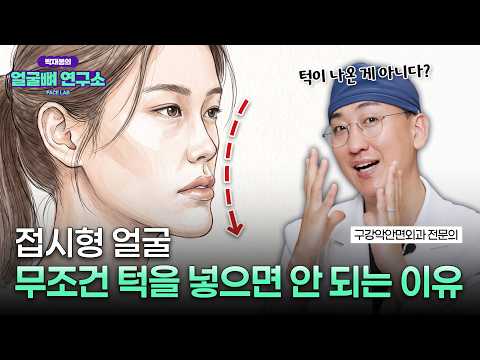
A. No. First, an accurate analysis is needed to determine which area is making the face look long. When the face is long because the midface (maxilla) is long, reducing only the chin can make the midface look even longer and the facial proportions more unnatural. This is because genioplasty is a facial contouring surgery that deals with the outer contour of the face and cannot change the length of the central face. Therefore, it is important to first identify the cause of the long-looking face with 3D CT or other methods and then decide on a surgical method suited to that cause.
A. Designing the osteotomy lines in consideration of the desired degree of change and stability, and fixing the cheekbone in a superior position, can greatly reduce sagging. When repositioning the cheekbone, designing the osteotomy lines in consideration of the desired degree of change and stability and pulling the bone upward to fix it (superior fixation) reduces sagging. However, excessive superior fixation or over-reduction of the cheekbone can instead cause problems, so it is important to maintain an appropriate level. Therefore, it is important to consider both the desired change and stability, and to discuss the amount of reduction and the degree of fixation thoroughly with the operating surgeon to set them at an appropriate level. The patient's own care after surgery is also an important part of reducing sagging.
A. None of them can be said to be the best. All three have their own advantages and disadvantages. What matters is choosing the method that suits your condition. To do so, it is recommended that you consult thoroughly with an oral and maxillofacial surgeon and an orthodontist.

Dr. Park’s Facial Bone Research Institute: FACE LAB