Frequently Asked Questions

MACS

  • Q
  • Q. Can orthodontics alone correct skeletal protrusion?

  • A. With a skeletal protruding mouth, it is difficult to completely eliminate the protruding appearance even with extraction orthodontics.

    When the upper and lower jawbones themselves protrude forward, or when the entire alveolar bone protrudes together with the jawbones, surgery to set the bone itself back is necessary. Surgical options include double-jaw surgery and ASO (protruding mouth surgery).

  • Q
  • Q. What are the types of protruding mouth?

  • A. A protruding mouth can be divided into two types according to the cause: dental protrusion and skeletal protrusion.

    • Dental protrusion: cases where the teeth flare forward and protrude
    • Skeletal protrusion: cases where the alveolar bone or the entire skeleton of the upper and lower jaws protrudes forward

    Because the treatment method differs depending on the cause, it is important to first accurately diagnose which type it is.

  • Q
  • Q. What are the symptoms of a protruding mouth?

  • A. Typical features are difficulty closing the mouth, or a sulky or retrognathic appearance when the mouth is closed.

    Because the lip tissue is relatively insufficient, it may be difficult to close the mouth comfortably. A gummy smile, in which a lot of gum is shown when smiling, is also one of the features, and in some cases the mouth does not close well, making the inside of the mouth feel dry.

  • Q
  • Q. What is a protruding mouth?

  • A. A protruding mouth is a condition in which the occlusion is generally aligned, but the skeleton or teeth protrude forward, giving a sulky impression.

    In many cases, aesthetic improvement is needed more than functional correction. When viewed from the side, if the upper and lower lips protrude beyond the line connecting the tip of the nose and the tip of the chin (E-line), it is commonly diagnosed as a protruding mouth.

  • Q
  • Q. How Far Can the Lower Jaw Be Set Back?

  • A. There is no fixed maximum; it can vary depending on the positions of the upper and lower teeth.

    The jaw is set back by the amount corresponding to the tooth angles established through pre-surgical orthodontic treatment, to align the occlusion. Therefore, how far it will actually be set back can only be determined once the surgical plan is made, and it is difficult to say "up to a maximum of so many mm" in advance.

  • Q
  • Q. Can Genioplasty Alone Correct Prognathism?

  • A. It is possible in some cases.

    In the following cases, it may be resolved with chin surgery (genioplasty) alone.

    • Cases where the occlusion between the upper and lower teeth is proper, the jaw does not protrude severely, and the length of the chin is the greater concern
    • Cases where the upper jaw is not severely retruded and the jaw does not protrude much: resolved by slightly setting back the chin and reducing its length
  • Q
  • Q. What Are the Risks of Excessive Jaw Setback?

  • A. Setting the lower jaw back significantly narrows the airway space behind the tongue, which can cause severe snoring after surgery.

    A narrowed airway can lower the overall quality of daily life, and the upper jaw may also look more retruded.

  • Q
  • Q. When is DJS needed for mandibular prognathism?

  • A. Depending on the case, double-jaw surgery is needed when the asymmetry is severe or the upper jaw is significantly retruded.

    • Severe asymmetry: double-jaw surgery may be required even if the anteroposterior position of the upper jaw is normal.
    • Retruded upper jaw: if the upper jaw has no asymmetry but is set too far back, double-jaw surgery that advances the upper jaw and sets back the lower jaw is needed.
  • Q
  • Q. Mandibular prognathism with lower jaw surgery alone?

  • A. It is possible depending on the case, but in many cases it is difficult to achieve proper occlusion with single-jaw surgery alone, so double-jaw surgery may be needed for more stable occlusion.

    If the midline of the upper jaw is aligned, there is no asymmetry, and the anteroposterior position of the upper jaw on CT is within the normal range, treatment can sometimes be completed with single-jaw surgery, which operates only on the lower jaw (mandible) to set the jaw back, combined with orthodontic treatment. However, in many cases it is difficult to achieve stable occlusion between the upper and lower teeth by moving only the lower jaw. In such cases, double-jaw surgery, which also moves the upper jaw, is considered.

  • Q
  • Q. Does mandibular prognathism always require surgery?

  • A. Not necessarily. Among people who visit thinking they have mandibular prognathism, there are quite a few who do not need surgery.

    Mandibular prognathism is not always treated with double-jaw surgery. It is best to decide after photographs, X-rays, 3D CT and other data have been analyzed together at an oral and maxillofacial surgery clinic and you have heard the specialist's diagnosis and explanation.

MACS YouTube

Dr. Park’s Facial Bone Research Institute: FACE LAB
  • FACE LAB
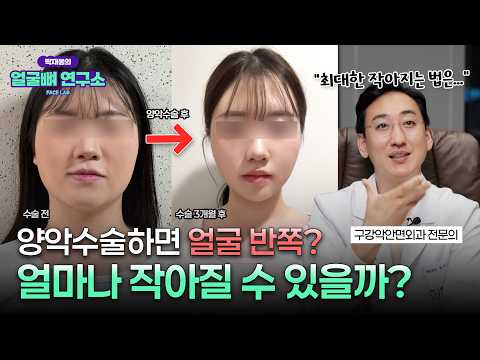
  • 양악수술로 얼굴 얼마나 작아질 수 있을까? ..
  • Watch Video FACE LAB
  • FACE LAB
  • 요즘 잘나가는 연예인들이 다 이 턱이라고?? (내 ..
  • Watch Video FACE LAB
  • FACE LAB
  • 현시점 Gen Z 윤곽 추구미 총정리|요즘 20살이 원하는 얼굴형은?..
  • Watch Video FACE LAB
  • FACE LAB
  • 중안부 꺼진 접시형 얼굴, 양악하면 될까요?|무조건 턱을 넣으면 안 되는 이유
  • Watch Video FACE LAB
  • FACE LAB
  • 발치교정 하면 양악수술 못하나요? 구강악아..
  • Watch Video FACE LAB
  • FACE LAB
  • 블랙핑크 지수·제니·로제·리사, 구강악안면외과 전..
  • Watch Video FACE LAB
  • FACE LAB
  • 양악수술의 역사와 발전|1세대부터 4세대까지 구강악안면외과 전문의의 총정리
  • Watch Video FACE LAB
  • FACE LAB
  • 치아 교정하면 양악수술 안 해도 될까? (부모님이 꼭 알아야 할 5가지)
  • Watch Video FACE LAB
QUICK
Consultation
  • Privacy Policy Agreement