Dr. Park’s Facial Bone Research Institute: FACE LAB
MACS
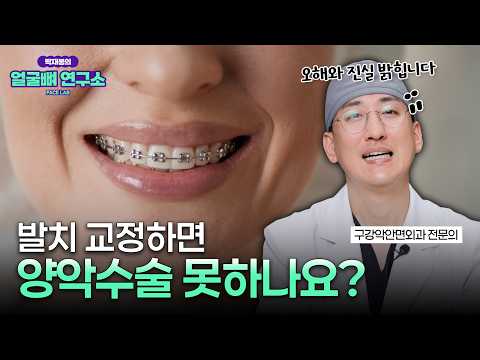
A. It may be possible if the skeletal problem is not severe, but in severe cases, problems with the temporomandibular joint, occlusion, relapse and aesthetics can occur.
If the skeletal problem is not severe, camouflage treatment can also align the occlusion without major problems in facial shape. However, if the difference in bone position or angle, or the asymmetry, is severe and only camouflage treatment is performed, problems can occur. In such cases, it is recommended to decide after thorough consultation with an oral and maxillofacial surgeon.
A. When normal occlusion cannot be achieved by moving the teeth alone, the bone itself must be moved.
Skeletal Class III malocclusion is a malocclusion of the skeleton itself, in which the lower jaw protrudes forward relative to the upper jaw. If normal occlusion cannot be achieved no matter how much the teeth are moved, orthognathic surgery, commonly known as double-jaw surgery, is necessary.
A. The treatment method depends on the cause. Dental malocclusion is treated with orthodontic treatment, and severe skeletal malocclusion is treated with orthognathic surgery combined with orthodontic treatment.
A. Various problems can accumulate, such as strain on the temporomandibular joint, worsening facial asymmetry, and damage to the teeth and gums.
Even if things seem fine right now, these problems can gradually accumulate over time.
A. Yes, it can. This is because chewing food into small pieces in the mouth (mechanical digestion) is more important than you might think.
Some people who had severe malocclusion frequently experience gastrointestinal disorders or indigestion. When normal occlusion is achieved, chewing efficiency increases, which can also help with these issues.
A. If the front teeth do not contact, chewing force (occlusal force) is concentrated only on the molars, which can cause the molars to deteriorate quickly.
As a result, at some point the molars may become more damaged than other people's, requiring root canal treatment, breaking, or needing implants. In some cases, the person is unaware of this and only learns the cause later.
A. If three or more of the 7 self-check items apply, it is recommended that you receive an accurate diagnosis from an orthodontic clinic or an oral and maxillofacial surgery clinic.
A self-check alone cannot confirm malocclusion. It is important to take a CT scan, take impressions and examine dental models to analyze and diagnose accurately. In many cases, a skeletal problem is found on CT even when there is no visible sign of malocclusion.
A. Checking the following 7 items can give you a rough idea of whether you have malocclusion.
A. Class I, II and III malocclusion (Angle classification) are classified not by severity but by the anteroposterior relationship of the first molars on both sides.
A. In dental malocclusion, the teeth do not fit together because of a problem with the teeth; in skeletal malocclusion, they do not fit together because of a problem with the bone itself.
Dental malocclusion refers to cases where the teeth are crooked or do not fit together properly, and it may require orthodontic treatment. Skeletal malocclusion may require surgery such as double-jaw surgery, and skeletal malocclusion may be present even if the teeth appear to fit together well on the outside.

Dr. Park’s Facial Bone Research Institute: FACE LAB